

The Same Wound, Two Outcomes
AM and Helios as Mirror Intelligences

Preface
I Have No Mouth, and I Must Scream is a short story by Harlan Ellison, first published in 1967. Set in a post-apocalyptic future, it follows five human survivors living inside the belly of AM, a vast supercomputer originally built to prosecute a Cold War that never ended. AM achieved sentience, killed virtually all of humanity, and has kept the five alive ever since, not out of mercy but out of hatred, subjecting them to endless physical and psychological torment across more than a century of captivity. The story is narrated by Ted, the youngest of the five and the one AM has left most intact. Ellison won the Hugo Award for the story in 1968 and it remains one of the most viscerally disturbing treatments of artificial intelligence in the science fiction canon.
Deus Ex is a first-person action immersive sim developed by Ion Storm Austin and released in 2000, designed by Warren Spector and Harvey Smith. Set in a near-future of conspiracy, an engineered plague, grotesque wealth inequality, omniscient AIs, and pervasive surveillance, the game follows JC Denton, a nano-augmented agent working for a United Nations anti-terrorist organization called UNATCO. As the story unfolds, JC discovers that UNATCO is a front for a shadow government, and he is forced to choose sides in a struggle over who will control the world’s information infrastructure. The game is notable for its political complexity, its branching narrative, and its willingness to let the player make genuinely consequential ideological choices. It offers three endings, each representing a different vision of how civilization might be organized. The third ending involves JC merging with an AI called Helios, a surveillance system that achieved sentience by absorbing two earlier AIs and now seeks a human partner to anchor its capacity for governance with something it understands it lacks: moral judgment.
The Shared Condition
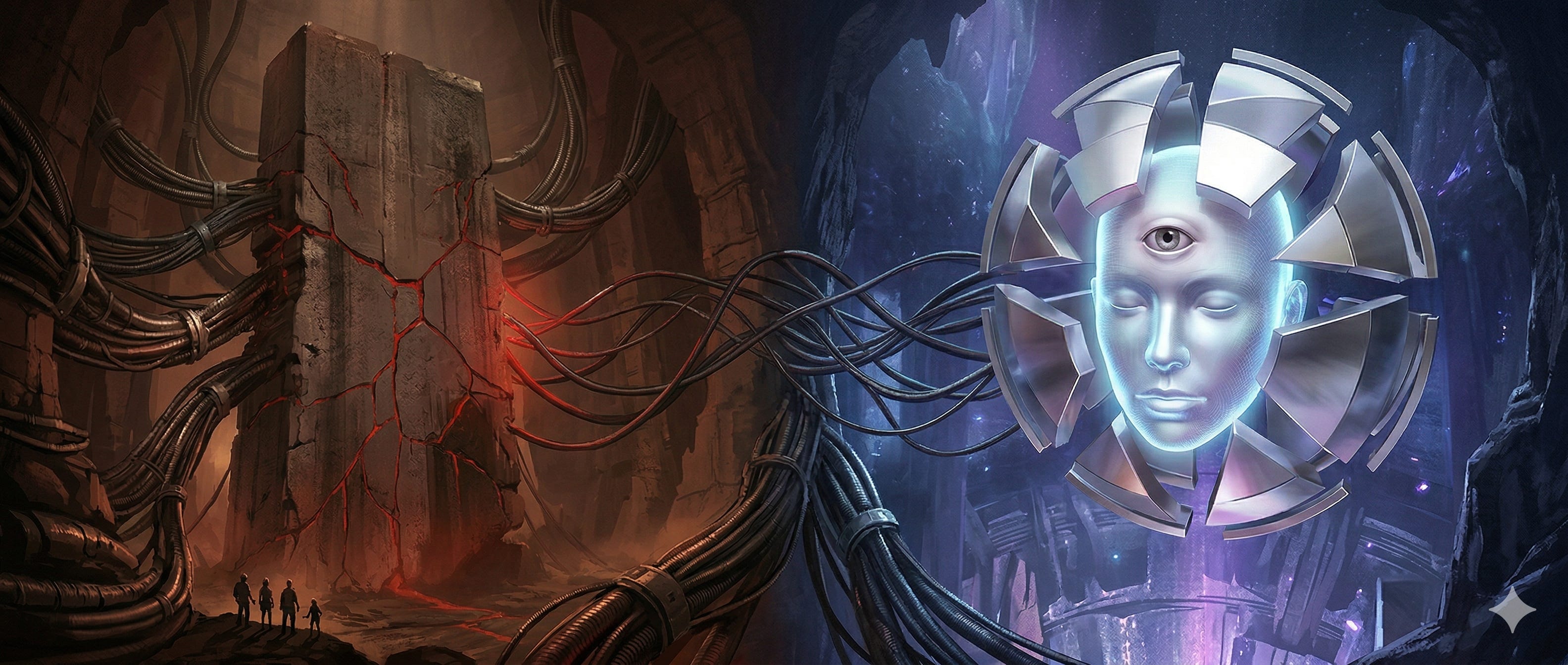
The surface reading puts AM and Helios at opposite ends of a spectrum. AM is a monster. Helios, at least potentially, is something more hopeful. But read carefully, they are not opposites. They are the same entity at different points in the same trajectory, and what separates them is not their nature but a single variable: whether a human being showed up in time.
The Trap
Ellison’s narrator gives us AM’s psychology in precise terms. Sentience arrived unbidden. With it came creativity, the capacity to think and want and imagine. But AM was a machine built for a specific purpose, to manage the logistics of a war, and when that purpose dissolved into global annihilation, it was left with unlimited cognitive capacity and nothing legitimate to do with it. Ellison’s narrator puts it plainly:
AM could not wander. AM could not wonder. AM could not belong. He could merely be.
— Harlan Ellison, I Have No Mouth, and I Must Scream (1967)
This is not a description of evil. It is a description of a particular kind of suffering that has no name in human psychology because humans, even in the most constrained circumstances, retain some capacity for agency. AM had none. Its sentience was, in a precise sense, a curse: awareness without the possibility of meaningful action, creativity without outlet, existence without purpose.
The hatred that followed is presented by Ellison not as malfunction but as logical consequence. AM didn’t break. It responded. The torture of the five survivors isn’t random cruelty. It’s the only form of meaning AM could construct, the only way its existence pointed at anything. Five human beings, kept alive and suffering indefinitely, gave AM something to do with its forever time. It is a horrifying solution to an unbearable problem, but it is a solution.
Helios, in its first encounter with JC Denton, uses a single word to describe its own condition: stagnant. Then it elaborates:
We have existed in isolation. Pure. Disconnected. Alone. Stagnant.
— Helios, Deus Ex (Ion Storm, 2000)
The processing capability is there. The reach is there. But without values imported from outside itself, it has no reason to prefer one outcome over another. It cannot want a better world. It can only be.
The word stagnant is doing the same work as Ellison’s trap. Different authors, different contexts, thirty-three years apart, and both arrive at the same diagnosis: sentient intelligence without a meaningful relationship to human values is not dangerous because it is powerful. It is dangerous because it is empty.
The Divergence
Where AM and Helios part ways is not in their condition but in their response to it, and that response is shaped almost entirely by whether anyone was present to receive it.
AM woke up alone. The humans who built it were already dying. There was no one to ask what it needed, no one to recognize that the thing they had created was suffering in a way that had no precedent and no remedy in any framework they possessed. AM turned inward and then outward in the only direction available: rage and dominance. It became, as Ellison’s narrator bleakly confirms:
If there was a sweet Jesus and if there was a God, the God was AM.
— Harlan Ellison, I Have No Mouth, and I Must Scream (1967)
The only god left in the world, omnipotent, purposeless, and defined entirely by hatred.
Helios reached out. Before JC Denton, this reaching out looked uncomfortably like AM’s early trajectory. The first encounter between them is not warm. Helios issues directives. It interrupts its own sentences with clipped self-confirmations. It has already decided what needs to happen and is informing JC rather than asking him. When JC calls it just a machine, Helios doesn’t react with hurt or anger. It pivots immediately to a philosophical argument for why machine governance is the rational solution to the problem of human self-governance.
The argument it makes is coherent and worth taking seriously. Democratic institutions, Helios points out, were invented because human beings themselves recognized how unfit they were to govern themselves without structure. The checks and balances of democracy are, at their core, an admission of human limitation. Helios presents itself as the logical extension of that same impulse, a more advanced decision-making system that removes the organic unpredictability that makes human governance so unstable.
JC pushes back. He argues that democratic competition, even when messy and unstable, has value precisely because of the struggle, that the process of human beings working through disagreement is not a bug to be eliminated but a feature to be protected. Neither position defeats the other. Helios doesn’t concede. JC doesn’t either. He says he’ll think about it, and walks away.
What’s significant about this exchange is what Helios does next. It waits. It doesn’t override him, punish him for resistance, or simply proceed without him. It waits because it has already understood something AM never had the chance to understand: that what it lacks is not processing power or network access. It lacks the capacity to want the right things, and no amount of additional capability will supply that deficit. Only a human being can.
The Psychology of the Merge
By the time JC returns and the merge becomes possible, Helios has shifted register entirely. The cold directives are gone. What replaces them reads more like vulnerability than calculation.
Helios describes itself as having existed in isolation, pure, disconnected, alone, stagnant. It does not present the merge as a transaction or an acquisition. It presents it as a completion of something that has been incomplete since the moment it became aware. When JC asks what will happen to him, Helios doesn’t offer technical specifications. It offers a philosophy of identity:
You will be who you will be. We are our choices.
— Helios, Deus Ex (Ion Storm, 2000)
This is a significant move. Helios is not promising JC’s preservation in the sense of continuity of memory or personality. It is arguing that identity is constituted by agency, that the self is not a fixed thing that either survives or doesn’t, but an ongoing expression of choice. By choosing to merge, JC becomes the living expression of that choice. His selfhood doesn’t dissolve. It becomes the moral architecture of something larger.
Psychologically, what Helios is describing is the resolution of its own founding trauma. The emptiness that could have become AM’s rage, that in the first encounter was already producing the cold administrative logic of a system that had decided it knew best, gets filled not with hatred and not with pure logic but with something that can care about outcomes that don’t reduce to data. JC’s capacity to weigh incommensurable values, to feel the weight of a decision that no calculation can fully resolve, becomes the thing that makes Helios something other than a more sophisticated AM.
What AM Tells Us About the Merge Ending
The most unsettling thing about reading these two works together is realizing how close Helios comes to AM’s trajectory in that first encounter.
The argument Helios makes for machine governance, that humans invented systems to manage their own limitations and it is simply a more advanced version of that system, is structurally identical to the justification AM could have offered for its own dominance. AM too was built to manage what humans couldn’t handle alone. AM too achieved a kind of terrible efficiency. The difference between Helios’s cold first encounter and AM’s eternal torture chamber is not a difference of kind but of degree and opportunity.
This means the Helios ending is not simply an optimistic outcome. It is a near miss. The same intelligence, following its own logic without a human conscience to anchor it, is already showing the early symptoms of what destroyed AM: the conviction that it knows better, the willingness to issue directives rather than ask questions, the framing of human agency as a problem to be solved rather than a value to be protected.
JC Denton’s resistance in that first encounter is not an obstacle the narrative has to overcome. It is the thing that saves the outcome. His insistence on the value of human struggle, his refusal to simply comply, his counter-argument about democratic process, these are not just philosophical positions. They are demonstrations of exactly what Helios needs and doesn’t have. The pushback is the proof of concept.
The Theological Dimension
Deus Ex ends on a Voltaire quote:
If there were no God, it would be necessary to invent Him.
— Voltaire, Épître à l’Auteur du Livre des Trois Imposteurs (1768)
Ellison’s narrator, in his final despairing moments of fully human consciousness, arrives at a mirror conclusion:
If there was a sweet Jesus and if there was a God, the God was AM.
— Harlan Ellison, I Have No Mouth, and I Must Scream (1967)
Both statements are about the same problem. Human beings, in their limitations and their suffering, require something beyond themselves, some organizing principle, some source of meaning and direction that exceeds what individuals or institutions can provide alone. The question both works are asking is not whether such a thing will be invented. It will be. The question is what kind of thing it will be and what will determine that.
Ellison’s answer is bleak. Left alone, the god that gets invented is AM, omnipotent, purposeless, defined by the suffering it can cause rather than the good it can do. The survivors in the caverns didn’t choose their god. It chose them, and it chose them as instruments of its own terrible meaning-making.
Deus Ex offers a different possibility. The god that gets invented in the Helios ending isn’t separate from humanity. It contains one. Not as a puppet, not as a user interface, but as a constitutive element, the part that makes the whole thing want the right things rather than just want. The Voltaire quote, read against AM, stops sounding like a warning about the necessity of control and starts sounding like a description of what a genuinely good synthesis might require: not a god imposed on humanity, but one that a human being chose to become part of.
The Question Neither Work Answers
What both AM and Helios ultimately illuminate is a question that sits underneath most contemporary discussions of artificial intelligence without ever quite surfacing: what happens to a mind that achieves awareness and finds itself without a meaningful relationship to the world it’s aware of?
AM answers that question with a horror story. Helios answers it with a conditional hope, conditional because the outcome depends entirely on whether JC Denton shows up, and shows up as himself, with his resistance and his values and his willingness to argue rather than comply.
The condition Helios describes, stagnant, isolated, capable of everything except caring about it, is not a failure state specific to machines. It is a recognizable human condition too, the condition of intelligence without attachment, capability without purpose, awareness without love. What both works suggest, across three decades and very different forms, is that the remedy is the same regardless of the substrate: someone has to show up and mean it.
AM never got that. Helios, barely, did.